
Learning Disability & Psychoeducational Assessments
Learning Disability & Psychoeducational Assessments
At our practice, we provide comprehensive Psychoeducational Assessments for children, adolescents, and adults. Our goal is to move beyond simple “labels” to provide a deep understanding of an individual’s unique learning profile, identifying both their cognitive strengths and the specific psychological processes that may be hindering their academic or professional success.
Following the latest Ontario Psychological Association (OPA) Guidelines, our assessments aim for consistency and accuracy, facilitating easier transitions between elementary school, high school, and post-secondary education.
At Niagara Neuropsychology, we offer 3 levels of assessment for Learning Disabilities (LD) (Psychoeducational Assessments) for children and adolescents ages 6 and up. These tiers are designed to provide comprehensive evaluations tailored to different needs and budgets, ensuring that all families can access quality assessments.

Virtual Reality Testing
TOP TIER—ADVANCED LD/PSYCHOEDUCATIONAL ASSESSMENT:
Our most comprehensive assessment for Learning Disabilities, including evaluations for co-occurring conditions such as ADHD and Autism Spectrum Disorder (ASD).
- Completion of a detailed background form
- 55-minute intake interview with Dr. Friesen or one the psychologists or psychological associates he supervises (charged separately at $250)
- Comprehensive cognitive/neuropsychological testing to assess cognitive abilities, including learning, memory, visuospatial skills, auditory processing, language, cognitive processing speed, attention, working memory, and executive functioning (~2-3 hours testing)
- Academic Achievement Testing to identify specific learning disabilities in reading, writing, and mathematics (~2-3 hours testing)
- Virtual Reality Attention Testing (i.e., 360 degree and 3-D).
- Continuous Performance Testing (CPT) is the gold standard for measuring selective and sustained visual and auditory attention, motor activity (hyperactivity), reaction time, and impulsivity (~30-minutes testing)
- For children and teens ages 6-16, Virtual Reality testing uses a classroom setting. See this video: https://youtu.be/_1veUQD968Y
- For teens and adults ages 16+, Virtual Reality testing uses an aquarium setting. See this video: https://youtu.be/2nc0WLxC7AY
- This can also be used to measure ADHD medication (e.g., Ritalin, Adderall, etc.) response to determine if the medication improves attention, hyperactivity, reaction time, and or impulsivity (~30-minute test)
- Optional Virtual Reality Executive Functioning Testing (i.e., 360 degree and 3-D) for ages 8-80 uses an ice-cream store setting which measures planning, working memory, processing speed, and cognitive flexibility( ~30-minute test). See this video: https://youtu.be/CmaqI2Arwew
- Optional Virtual Reality Memory Testing (i.e., 360 degree and 3-D) for ages 12-90 uses a furniture store setting and measures immediate and delayed verbal and visual memory and learning (~30-minute test). See this video: https://youtu.be/iBwi0Gh_yc0
- Continuous Performance Testing (CPT) is the gold standard for measuring selective and sustained visual and auditory attention, motor activity (hyperactivity), reaction time, and impulsivity (~30-minutes testing)
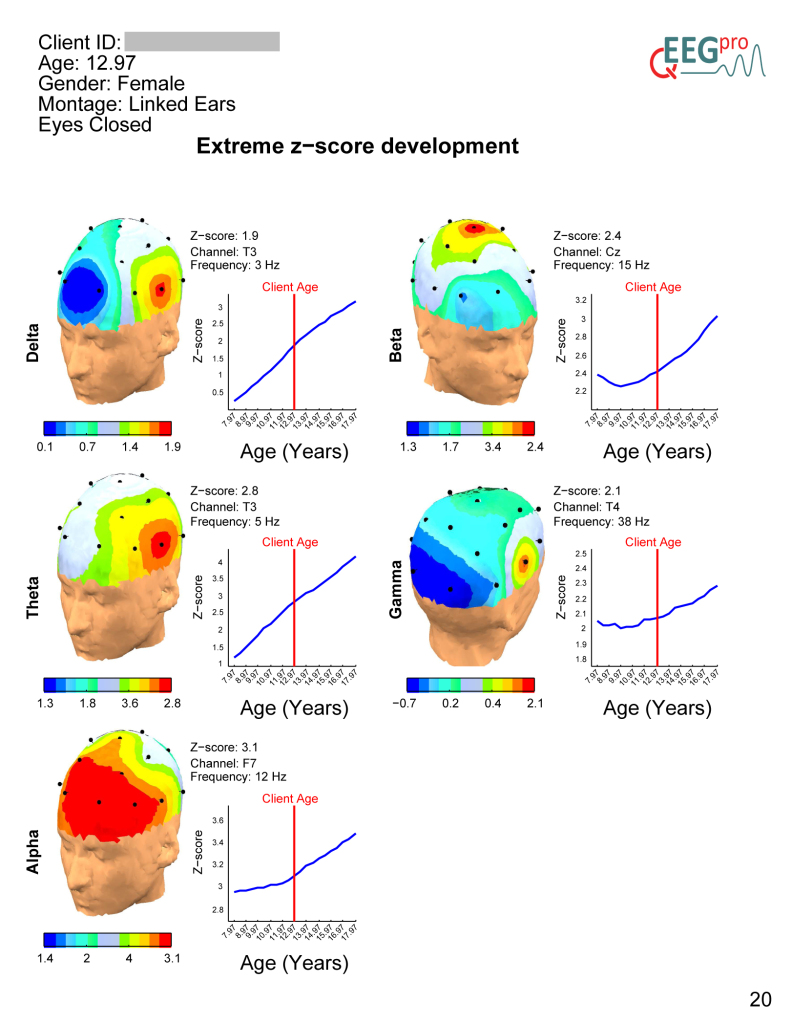
- Whole-brain quantitative electroencephalograph (qEEG) — brain mapping to assess brain function and identify potential neurological markers (~1-hour test)
- Full psychophysiological stress testing to directly measure anxiety, coping, and stress regulation (~30-minute test)
- Parent/teacher/self-rating measures of executive functions, ADHD, and psychosocial functioning (~15 minutes each)
- Psychological testing to assess emotional and behavioral functioning (~30-60 minutes)
- A detailed review of report cards and academic samples (if required).
- 60-minute feedback session with Dr. Friesen or one the psychologists or psychological associates he supervises to discuss findings and treatment options
- Detailed report provided for educational planning and accommodations, if required
Cost: $3500 (not including the $250 intake session fee)
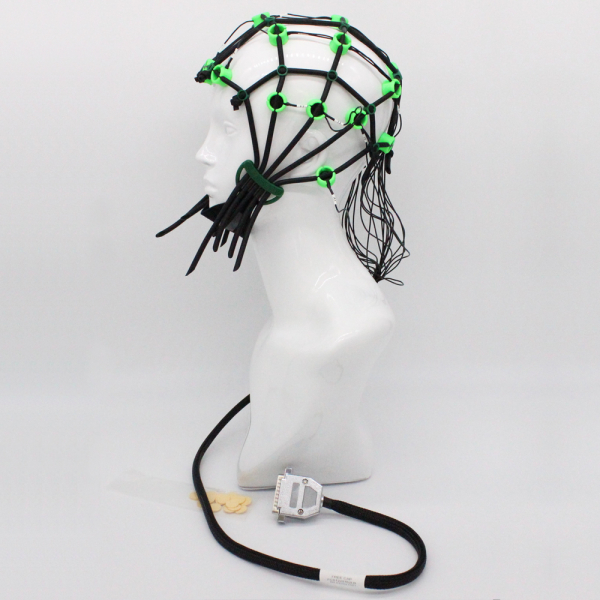
qEEG Brain Mapping
MIDDLE TIER—INTERMEDIATE LD/PSYCHOEDUCATIONAL ASSESSMENT:
A thorough Psychoeducational Assessment for Learning Disabilities with essential components for a detailed understanding of the child’s learning profile.
- Completion of a detailed background form
- 55-minute intake interview with Dr. Friesen (charged separately at $250)
- Comprehensive cognitive/neuropsychological testing to assess cognitive abilities, including learning, working memory, visuospatial skills, auditory processing, language, cognitive processing speed, attention, and executive functioning (~2-3 hours testing)
- Academic Achievement Testing to identify specific learning disabilities in reading, writing, and mathematics (~2-3 hours testing)
- Whole-brain quantitative electroencephalograph (qEEG) — brain mapping to assess brain function (~1-hour test)
- Full psychophysiological stress testing to directly measure anxiety, coping, and stress regulation (~30-minute test)
- Parent/teacher/self-rating measures of executive functions (with ADHD screening), ASD screening, and psychosocial functioning (~15 minutes for each questionnaire)
- Psychological testing to assess emotional and behavioral functioning (~30-60 minutes)
- A detailed review of report cards and academic samples (if required).
- 60-minute feedback session with Dr. Friesen to discuss findings and treatment options
- Summary report provided for educational planning
Cost: $2800 (not including the $250 intake session fee)
LOWEST TIER—LD/PSYCHOEDUCATIONAL SCREENING:
A focused screening to identify potential learning disabilities, providing a starting point for further evaluation if needed (i.e., no diagnosis will be provided).
- Completion of a detailed background form
- 55-minute intake interview with Dr. Friesen (charged separately at $250)
- Brief cognitive/neuropsychological screening to estimate intellectual abilities and briefly assess verbal abilities, visual-spatial abilities, cognitive processing speed, attention, and working memory (~1-2 hours of testing)
- Academic Achievement Screening to identify potential learning disabilities (~1-hour testing)
- Psychological testing to assess emotional and behavioral functioning (~30-60 minutes)
- Parent/teacher/self-rating measures of executive functions & psychosocial functioning (~15 minutes for each)
- A detailed review of report cards
- 60-minute feedback session with Dr. Friesen to discuss findings and recommendations
- Screening summary provided for initial educational planning
Cost: $1800 (not including the $250 intake session fee)
Note:
- Insurance Coverage: Many extended health benefit plans cover psychological services. Please check with your provider (we do not directly build them. You submit your receipts)
- Value Proposition: As a Neuropsychologist, our assessments provide a deeper understanding of your child’s learning profile, beyond standard evaluations.
This structure should help parents understand the options available and choose the assessment that best fits their needs and budget. Let me know if you need further customization or additional details!
Our Assessment Approach
Similar to our ADHD services, we offer specialized levels of assessment tailored to the individual’s history and needs. Every assessment follows a rigorous 10-step process designed to rule out external factors and pinpoint the root cause of learning struggles.
Step-Wise Diagnostic Process:
- Detailed History: Investigating academic impairment and excessive effort used to maintain grades.
- Risk Factor Screening: Reviewing developmental, health, and educational history.
- Standardized Achievement Testing: Measuring current skills in reading, writing, and mathematics against age-based norms.
- Psychological Process Assessment: Testing specific areas like phonological processing, working memory, and processing speed.
- Thinking & Reasoning Evaluation: Assessing global intellectual abilities in addition to strengths and weaknesses within specific cognitive areas.
- Social-Emotional Screening: Identifying comorbid concerns like anxiety or ADHD that often co-exist with learning disabilities.
- Diagnostic Formulation: Synthesizing data into a formal clinical report.
- Evidence-Based Recommendations: Creating recommendations for interventions and, if required, accommodations.
- Communication: A dedicated feedback session and a comprehensive report for parents and schools.
What is a Learning Disability (LD)?
A Learning Disability is a neurodevelopmental disorder that persistently impacts the ability to learn and use academic skills. It is diagnosed when a person demonstrates academic achievement well below their age level, despite having at least average abilities for thinking and reasoning.
A formal diagnosis requires evidence in three main areas:
- Academic Impairment: A history of struggling in school or requiring excessive time and support to keep up.
- Below-Average Achievement: Scores at least one standard deviation below the mean in reading, writing, or math.
- Cognitive Process Deficit: A logical link between academic struggles and a deficit in one or more psychological processes, such as:
- Phonological Processing (essential for reading/Dyslexia)
- Working Memory (holding and using information)
- Processing Speed (how quickly information is handled)
- Executive Functioning (planning and organizing)
- Visual-Spatial Abilities
Types of Learning Disabilities We Assess
Reading (Dyslexia)
Dyslexia is a specific subset of learning disabilities characterized by difficulties with accurate or fluent word recognition, poor decoding, and weak spelling. While many individuals learn to decode words over time, they may continue to struggle with reading fluency, which can significantly impact comprehension and academic endurance.
Writing (Dysgraphia/Written Expression)
Difficulties in writing can range from graphomotor issues (handwriting and fine motor speed) to complex problems with written expression, such as organizing ideas, grammar, and sentence structure. Spelling difficulties can also fall under this category.
Mathematics (Dyscalculia)
This includes challenges with basic numeracy and calculation, such as understanding number facts, as well as math problem-solving, which often involves the ability to process visual-spatial information or translate language into mathematical operations.
Non-Verbal Learning Disability (NLD)
While a debated diagnosis, NLD typically describes a profile of strong verbal skills contrasted by significant deficits in visual-spatial, motor, and social-communication domains. We carefully evaluate these profiles to determine if they meet the criteria for a learning disability in math or if other diagnostic considerations, such as Autism Spectrum Disorder, are more appropriate.
Why Seek a Professional Assessment?
Early and accurate identification is critical. Research shows that early intervention—particularly in grades one and two—can significantly improve long-term outcomes. Furthermore, for adults and post-secondary students, a formal psychological assessment is often required to access academic accommodations (like extra time or memory aids).

Leave a Reply
Want to join the discussion?Feel free to contribute!